The Limits of Palliative Care: The Inconvenient Truth of Palliative Care Physicians in Japan ①
- リップディー(RiP:D)

- 4 days ago
- 7 min read
[The Limits of Palliative Care: The Inconvenient Truth About Palliative Care Physicians in Japan ①]
If you don't know about palliative care and sedation, click here.

・The House of Commons conveys the limitations of palliative care
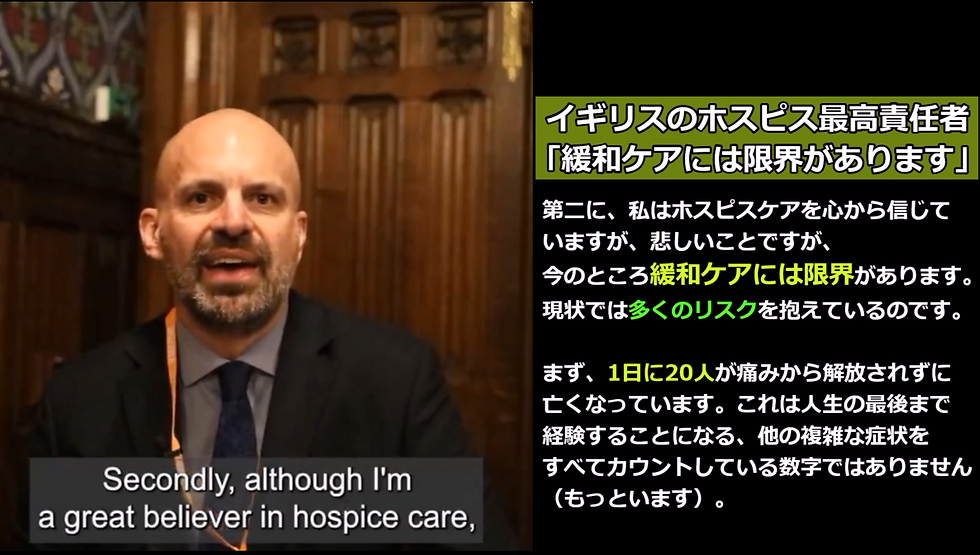
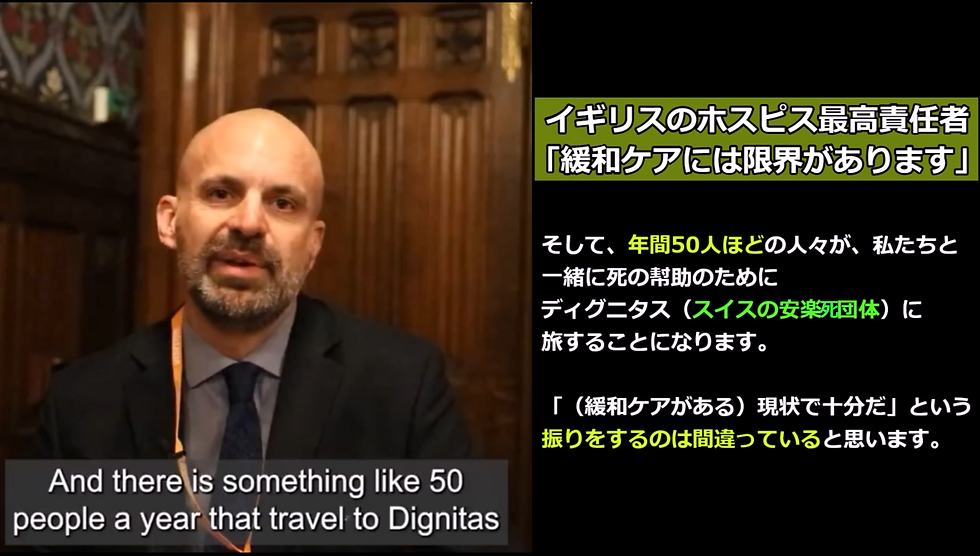
First, please take a look at this 4 minute 16 second video.
This shows a parliamentary debate taking place in the UK House of Commons, based on materials from a report submitted in order to advance the euthanasia bill .


・Specific contents of the report
Here is the report submitted to the British House of Commons:
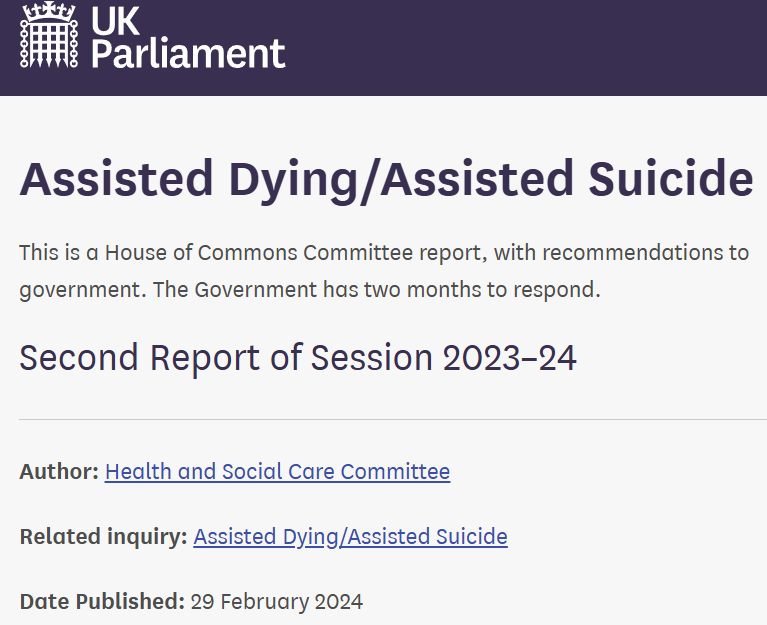

(You can also download the report in PDF format.)

Pay attention to Chapter 4
・Palliative care in the UK


Summary of the above:
A report from the Bureau of Health Economics published in 2019 pointed out that there is abundant evidence of the difficulties of adequately controlling patients' pain in palliative care .
For example, a recent study in England (Royal College of Physicians, 2016) found that:
A detailed review of 73% of the case records revealed that pain was adequately controlled in 79% of cases .
It has been reported that 21% of palliative care patients who died in hospital were left with unrelieved pain .
Furthermore, this “unrelieved pain rate” can be compared with the VOICES survey (Office for National Statistics, 2016b), which was conducted among family members and carers of patients who died in hospital.
The VOICES survey showed the following results:
Up to 32% of patients had incomplete pain relief
The breakdown is as follows:
4% experienced no pain relief at all
28% had only partial pain relief
⇩
In other words, despite receiving palliative care, approximately 20% to 30% of patients die in pain .
The video at the beginning points this out.
" It is a mistake to think that palliative care alone is sufficient for end-of-life care. The above data is precisely why a euthanasia system is necessary ."
They are claiming that:
・Palliative care in countries where euthanasia is legal
・Canada example


Summary of the above:
According to the latest report published by Health Canada in 2022 (data covered is from 2021), of those who chose physician-assisted euthanasia,
The majority, 80.7%, had already received palliative care
This trend has not changed significantly from the past few years, with the percentages remaining similar in both years, at 82.1% in 2019 and 82.8% in 2020.
Furthermore, it has been reported that 52.6% of people who died by euthanasia received palliative care services for more than one month .
In this respect, too, it is roughly at the same level as in 2019 and 2020.
Additionally, starting in 2024, Health Canada will begin collecting detailed information on the type of palliative care that euthanasia applicants received, and where .
As a result, it is expected that data on the relationship between palliative care and euthanasia will become more precise and accurate in the future.
・Examples from New Zealand, Australia, and the United States
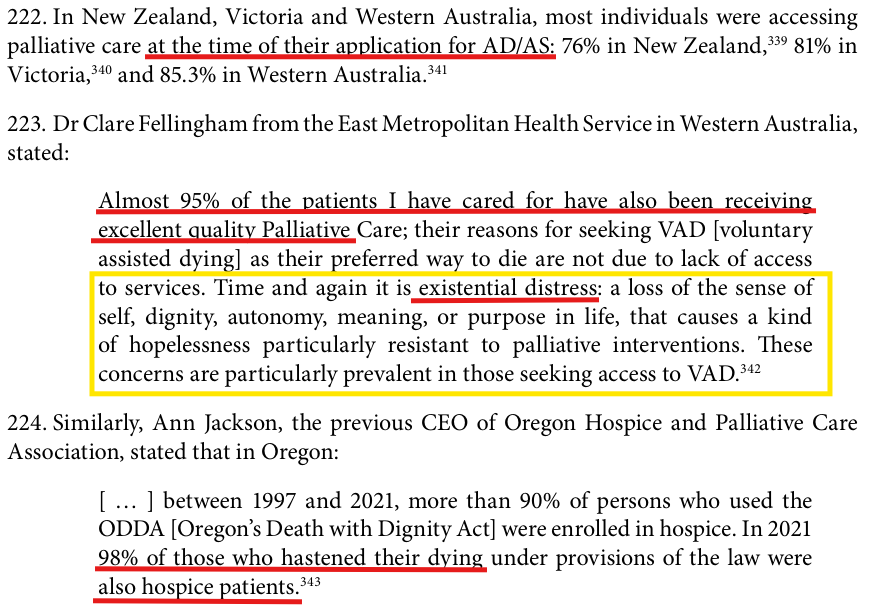

Summary of the above:
In New Zealand, Victoria and Western Australia,
The majority of people requesting euthanasia have accessed palliative care beforehand .
76% in New Zealand
81% in Victoria,
In Western Australia, it reaches 85.3% .
Dr. Fellingham of Western Australia also stated that approximately 95% of patients requesting euthanasia receive high-quality palliative care , and that the reason they choose to end their lives is not because of a "lack of palliative care."
Loss of dignity and autonomy, existential distress,
Often stems from deep despair that is difficult to alleviate even with palliative care
He points out that:
Similarly, the situation is similar in Oregon, USA, where over 90% of people who used euthanasia between 1997 and 2021 were registered with a hospice , and 98% were hospice users in 2021 .
In other words, it has been commonly observed that many people seeking euthanasia are suffering from unrelieved pain, despite already receiving adequate palliative care .
⇩
It is true that palliative care has its limitations, but Japanese palliative care physicians refuse to acknowledge this.
"If we make palliative care more widespread, everyone will be able to die peacefully."
"With palliative care, there's no need to go to Switzerland to commit suicide."
This is the kind of propaganda being spread in the media.
・Summary of countries around the world that communicate the limitations of palliative care (The Limits of Palliative Care: The Inconvenient Truth of Palliative Care Physicians in Japan)
England :
21% of patients receiving hospital palliative care have incomplete pain control , and 32% only receive partial pain relief (Royal College of Physicians, 2016; VOICES survey, 2016)
10-15% of cancer patients suffer from treatment-resistant pain (pain that is not responsive to medication), and up to 30% continue to report pain.
Even with optimal hospice care, 50,709 people die annually with some degree of pain , and 5,298 of those die without any relief in the last three months of their life (Office for Health Economics model)
Many patients have testified that "even with the best care, the unbearable pain and despair continue, and it feels like treating animals worse than humans," and there have been reports of MS patients planning suicide due to the "pain with no way out" (Dr. Matthew Doré testified: "Despite our best efforts, the symptoms are unmanageable and the suffering is prolonged").
*Countries where euthanasia and dignified death are legal
(All of these countries have extremely high rates of palliative care consultations of 70-95%)
Canada :
- 77.6% of users chose MAID (also known as assisted dying) despite receiving palliative care , 40% only used it for a short period of less than one month, and 16.8% refused it despite having access to it.
Reasons cited include loneliness (17.1%) and feeling like a burden on family (35.3%), with non-cancer diseases (e.g., neurological disorders) accounting for 3.5% of cases, and the number of cases has risen sharply (44,958 cases since 2016, 4.1% of causes of death).
Oregon (USA):
91.4% of the users were in hospice or palliative care, and 46% had their euthanasia plans canceled due to care intervention, while 15% still chose euthanasia .
The number of deaths is expected to increase (2022: 0.6% of causes of death) due to reasons such as the burden on families (48%) and concerns about medical costs (125 cases reported).
Australia (Victoria) :
81% were receiving palliative care , but of the 306 applicants up to June 2023, 76% were terminal cancer patients, and 66% actually used the medication after it was prescribed.
Mental suffering such as "loss of self and loss of dignity" leads to resistance to care.
Belgium and the Netherlands :
After legalization, the government doubled its palliative care budget , but the number of euthanasia cases has actually increased (Belgium 2021: 2,700 cases, cancer 62.8%, neurological diseases 7.9% / Netherlands 2022: 8,720 cases, cause of death 5%, cancer 57.8%, neurological diseases 7.0%, psychiatric diseases 1.3%).
Cases of mental illness also show the limitations of palliative care due to the deep emotional suffering (hopelessness).
*addition:
European Association for Palliative Care (EAPC) 2019 Report:
EAPC investigated approximately 30,000 palliative cases in 27 European countries and found that
15-30% of terminal cancer patients do not achieve complete pain relief even with optimal treatment
20-40% of patients with neuropathic pain continue to suffer from intractable pain
He concludes that:
WHO Technical Report (2018):
In a global survey, WHO
"Refractory pain" occurs in approximately 10-20% of all terminally ill patients
Even with opioids such as morphine and fentanyl, there is a certain percentage of cases in which pain is only "reduced" rather than eliminated.
It clearly states the structural problem that as the body adapts to drugs and tolerance builds up, side effects only increase .
- The existence of "difficult-to-relieve suffering" other than pain
(Palliative care has limited effectiveness for dyspnea, fatigue, and existential distress, in addition to pain.)
dyspnea
The Lancet Respiratory Medicine (2017)
65-70% of terminally ill patients experience shortness of breath
・Of these, 25-35% "do not respond adequately to drug treatment."
Even with the combined use of opioids, oxygen therapy, and steroids, "complete relief is extremely difficult"
Fatigue/general weakness (fatigue)
Journal of Pain and Symptom Management (2020)
Average improvement rate of fatigue in palliative care: 20-30%
In other words, 70-80% of cases "symptoms remain"
Existential suffering
Analysis of Canadian MAID Cases (2021) The top complaints of those seeking euthanasia are:
Loss of dignity (87.7%)
Loss of independence (86.3%)
Loss of activity (83.4%)
Uncontrollable pain (57.6% )
This shows that "pain" is not the direct cause, but rather that the most serious suffering is " the destruction of one's existence as a human being ."
Medically, this "existential distress" is rarely alleviated by medication .
[Conclusion]
Approximately 80% of patients who receive palliative care are able to die peacefully.
The remaining 20% die a tragic death accompanied by pain.
・In other words...
No matter how extensive and widespread palliative care services are,
Whether or not the patient receives the service...
The desire for a peaceful death (euthanasia) at the end of one's life is universal
・Japanese palliative care doctors are responsible for the "20% of patients" who die in pain for some reason.
They are intentionally ignoring this fact, and not only are they concealing it, but they are also propagating the idea that palliative care is omnipotent.
![A woman's post on [What My Mom Decided: A Family's Record of Facing Life].](https://static.wixstatic.com/media/1e6e15_b00396f38c674b13b62c8130b504042f~mv2.png/v1/fill/w_729,h_829,al_c,q_90,enc_avif,quality_auto/1e6e15_b00396f38c674b13b62c8130b504042f~mv2.png)
Fuji TV The Non-Fiction
[What my mother decided: A family's record of facing life and death]
(The female X account is here ⇒ @mahomelc)
Mayumi's X account name is "Meishii" .
![A woman's post on [What My Mom Decided: A Family's Record of Facing Life].](https://static.wixstatic.com/media/1e6e15_df7d610e42f04aa18aff1d1bfa15afe8~mv2.png/v1/fill/w_641,h_125,al_c,q_85,enc_avif,quality_auto/1e6e15_df7d610e42f04aa18aff1d1bfa15afe8~mv2.png)

Unfortunately, the attitudes towards euthanasia of all doctors (especially palliative care doctors: *will be made public in due course) appearing in the media are as shown below.

The doctor who honestly speaks publicly about the limitations of medical technology (palliative care) is also a famous novelist.
The only one I know is "Hitsuji Kusakabe."

... He made the extremely irresponsible statement that "with advances in palliative care, the painful symptoms of terminal illness can be almost completely eliminated."
I am left speechless at the extent to which people place too much trust in medical care, but even if we take it at face value, ``almost completely removable'' means that there are cases where it cannot be removed, and euthanasia is necessary as an option for such people .