
[Euthanasia in Swiss #1] History and Current Situation
- リップディー(RiP:D)

- Nov 20
- 7 min read
[Euthanasia in Swiss: History and Current Situation]
In recent years, the image of "Switzerland" has become firmly established when people hear that euthanasia (or more accurately, "assisted suicide") is available to Japanese people (or foreigners). In fact, the history of euthanasia in Switzerland is long and interesting.
First, the debate on euthanasia (assisted suicide) in Switzerland began in 1942, based on existing legislation .
Article 115 of the Swiss Criminal Code states:
" If you induce or assist someone to commit suicidefor selfish reasons,
He will be punished by imprisonment for not more than five years or a fine."
And this can be interpreted as follows:
"So, does that mean it's okay to encourage or assist others in committing suicide, as long as it's not for selfish reasons ? "
This became the legal basis for subsequent euthanasia groups (or, more precisely, assisted suicide groups). To put it bluntly, it could be described as a "far-fetched theory" or "an exploitation of a loophole in the law" (the author's impression).
In the first place, Article 115 of the Penal Code has nothing to do with the "so-called theme of euthanasia," and it is said that the background to it was as follows.

The key phrase is,
・Support for those who commit suicide to protect their own or their family's honor
- Rejected by his lover, he commits suicide in despair.
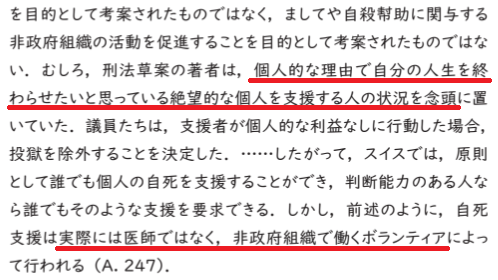
The key phrase is,
- Support for desperate individuals who wish to end their lives for personal reasons
・There is no meaning to doctors assisting patients with serious illnesses in committing suicide, as there is today.

source:
[Considering Euthanasia: Comparing the Compassionate Model and the Liberal Model in Various Countries]
Hardcover – November 27, 2023 by Shinichiro Morinaga
This background and way of thinking seems to have been cultivated in Switzerland in the 1930s, before World War II.
- It must not be for selfish reasons (this is an absolute rule)
・(=If there is no intention to commit a crime such as for money or inheritance)
- To fulfill the wishes of those who wish to commit voluntary suicide
・"Assisting" in this is not a crime
It can be understood this way. It is different from the "euthanasia in general" debate that is currently the subject of debate around the world.
Some people sometimes praise Switzerland, saying, "Euthanasia has been permitted in Switzerland since 1942, it's amazing!" However, the origins of this idea are unrelated to medical issues and could be considered a bit of a misunderstanding.
To use a rough analogy, in the Edo period
Is this an expression that means, " The person who beheads a samurai who is about to commit seppuku is not guilty of murder "?
This was mentioned in the section on active euthanasia.
- The logic that "the fundamental principle of abortion is that it is tantamount to murder, but under certain conditions it is legal (decriminalized) for pediatricians"
- The legality of the "officer who presses the death penalty switch"
The theme of "murder in self-defense"...there are some similarities.
Later, in 1982 , the world's first assisted suicide organization, Exit, was founded, marking the beginning of modern euthanasia in Switzerland.
*It seems that there have been small assisted suicide groups since ancient times, but in terms of name recognition and an organization that is still active today, Exit can be said to be the world's first euthanasia association .
There are currently around seven assisted suicide organisations in Switzerland. Among them, the one that is particularly well known in Japan is:
Dignitas, founded in 1998
It would be LifeCircle, which separated from there and became independent in 2011.


You can watch this documentary for free at the following page:

Life Circle is frequently featured on Japanese television and is widely recognized, but unfortunately, we are no longer accepting new applications after 2022 .
There is also a relatively new organization called Pegasos , which was founded in 2019 by a former coordinator of DIGNITAS and is gradually gaining recognition.
For beginners interested in euthanasia (assisted suicide) in Switzerland, it is a good idea to first familiarize yourself with the following four organizations.
1982:
Exit — open to all nationalities, but only for Swiss residents
1998:
Dignitas — available domestically and internationally
2011:
LifeCircle — Same as above (but no new applications accepted after 2022)
2019:
Pegasos — Same as above
In the sense of "regardless of nationality," there are other There are also organizations such as Exit International and The Last Resort , but these are quite unique in nature, so we will introduce them in detail on another occasion.
Looking at the trend in the number of users, it has been increasing year by year.

The ratio of Swiss domestic users to foreign users is roughly as follows:
Domestic (Swiss citizens and residents): Approximately 1,000 people per year
Foreigners: Approximately 500 people
→ It's probably safe to assume that a total of about 1,500 people choose assisted suicide each year (this number will likely increase in a few years).
In fact, 1,594 cases were reported in 2022.
In Switzerland, the two organizations mentioned earlier, Dignitas and Pegasus , are representative organizations that accept foreigners, including Japanese people.
In addition, an important point is that
Switzerland does not have a "euthanasia system" (a system codified by national law) .
In other words, the state does not institutionally mandate or guarantee euthanasia by a physician, but rather "assisted suicide" is decriminalized (although it is permitted as long as there is no "selfish motive").
In fact, a proposal to "legalize or abolish euthanasia (assisted suicide) as a national system" was once put to a referendum on a cantonal level (in the canton of Zurich), but was rejected by a majority of voters .
*The proposal was rejected in a referendum on May 15, 2011 , with approximately 85% of people opposed to the ban and approximately 78% opposed to the tourism ban. In other words, the current situation is that many citizens support a system of private euthanasia.
Please keep in mind that the "Swiss method" is somewhat different in nature from the euthanasia systems rooted in the medical systems of the Netherlands and Canada.
Also, due to the nature of the system, people other than Swiss citizens (foreign nationals) are relatively accepted.
Supplement: Recent notable trends and latest information (Swiss euthanasia)
-Increase in the number of euthanasia (assisted suicide) cases
According to the Swiss Federal Statistical Office, 1,729 people will choose assisted suicide in 2023, an increase of around 8.5% from 1,594 in 2022.
Of these , 1,036 (approximately 59.9%) were women and 693 were men, and the proportion of women continues to be high .
In addition, by 2023, 91% of the population will be 65 years or older , indicating a very high proportion of elderly people .
・Increase in organization membership
Exit (which operates mainly in German-speaking countries) has seen its membership reach an all-time high, reaching approximately 154,000 members as of the end of 2022.
Dignitas also expects to have approximately 12,000 members in 2022, with many of its new members coming from the United States, Germany, the United Kingdom, and other countries.
As mentioned in the Dutch article , " couple euthanasia " is possible in Switzerland, but at Dignitas, only a small proportion of couples actually choose this option, with only 206 people choosing it in 2022.
Guidelines and Ethics
The Swiss Medical Association issued guidelines in 2022 stating that assisted suicide may be ethically justified for "adults who are competent and express a consistent wish to die." The Swiss Medical Association supports euthanasia.
・New Technology・Suicide Capsule Discussion
The Sarcopod, a device created by Philip Nitschke, has shocked the world. This device uses nitrogen to create a hypoxic state, allowing the user to die by operating it themselves, without the need for a doctor. It was first implemented in Switzerland.
This technology has sparked new debate from ethical and legal perspectives, as it could enable assisted suicide outside of the traditional medical and institutional framework . We will be covering Sarco in a separate article in the future.
remarks
・" Euthanasia in Switzerland "... That phrase is not wrong, but strictly speaking, the correct answer is "Going to Switzerland to receive assisted suicide (AVD)."
-In Switzerland, the term equivalent to euthanasia is AVD (assisted voluntary death) .
As mentioned in this article, it can be considered a subtype of VAD (voluntary assisted dying). In other words, if you are planning to visit the area, please be careful not to use the words euthanasia or maid.
Of course, the local staff will be understanding and will treat you well, but they probably won't leave a very good impression.
- The number of foreign nationals using euthanasia services in Switzerland is increasing every year .
As this article shows, the reason why countries are creating their own euthanasia systems is because there are now so many people seeking euthanasia that Swiss organizations alone cannot "handle" them.
The Swiss euthanasia organization, Dignitas, has even issued a strong statement saying, "The UK should not outsource the processing of euthanasia requests (do not send them to Switzerland). They should create their own system !" (This shows that the legalization of euthanasia is becoming a global trend.)
In other words, I suspect that eventually the acceptance of Japanese nationals as foreign nationals will end . In a few years, it is likely that only people from neighboring countries will be eligible, excluding Asian countries . Signs of this are already emerging, with people in Japan who are completing procedures to travel to Switzerland experiencing communication disruptions and delays .
If you are hoping to move to Switzerland someday, you will need to "time your move."