
[Euthanasia in Canada #1] Current Status and Performance Data Maid (Active Euthanasia/Assisted Suicide)
- リップディー(RiP:D)

- Nov 15
- 7 min read
[Euthanasia in Canada] Current status and performance data
In Canada, the word "euthanasia" is not used.
This is called MAID (Medical Assistance in Dying) .
*By the way, in America, Maid stands for Medical aid in dying (which can be confusing).
*As this is the first article about Canada, I will introduce the minimum necessary knowledge by showing simple keywords and data. From next time onwards, I will go into more detail, so for now, let's get the basic information down.
Rapid increase in number of users (euthanasia in Canada)
Canada's euthanasia system (MAID: Medical Assistance in Dying) was passed in 2015 and officially came into effect in 2016 .
In addition, the law was amended in 2021 , and as will be discussed below, the scope of euthanasia has been expanded to include non-terminal illnesses (although the screening process has become stricter).
Looking at this graph of utilization rates up to fiscal year 2023 , we can see that the number of users has grown significantly since the system was launched.
Since the system was launched, the number of users has soared , it could be said, and the rate of increase has been extremely rapid.

In the Netherlands , over the 20 years since the system was established, the proportion of euthanasia cases among annual deaths has exceeded 5%.
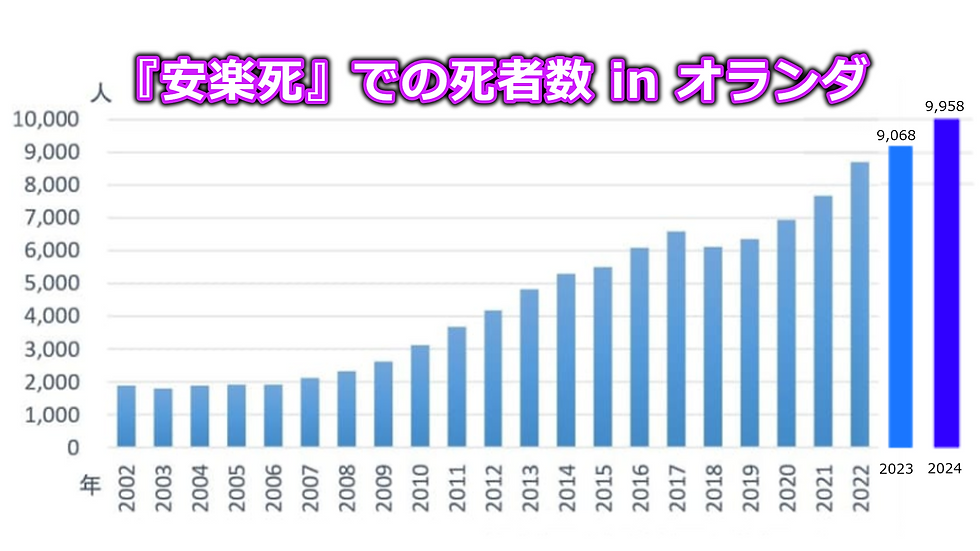
On the other hand, Canada has reached 4.7% (2023) in just seven years , and is on the verge of 5%.
In the Netherlands, the number is expected to increase by 5.8% (9,958 people) by 2024, but Canada is on track to overtake that 20-year journey in just a few years .
(For reference, suicide accounts for approximately 2.4% of all deaths in Japan each year .)
*This sudden increase has apparently caused religious groups in Canada ( especially evangelical Christians ) to react sensitively and feel anxious, and they are spreading conspiracy-like criticism around the world through the media, which is a very natural thing to do (we will explain this later).
There are three main reasons for this sudden increase.
・Background to the introduction of the system:
A history of citizens winning their rights through lawsuits (pride)
・Advantages of latecomers:
The system design know-how of other countries was already in place ( heavy influence from the Netherlands )
-Canada 's cultural and political background, which emphasizes the right to self-determination
In other words, the environment was in place to allow the system to go through the development stages in the shortest possible time.
We will report on the lawsuit and the implementation process in a separate article.
Euthanasia (Maid) eligibility criteria
・Age 18 or older
・Mental health = Ability to make decisions
- Have a serious illness or disability
Advanced state of decline
Unrelenting psychological distress, impairment, or debilitation
Please note that if the underlying condition is a "mental illness," it is not covered. This differs from the Netherlands, the Benelux countries, Germany, and Switzerland, where mental illness is also covered.
In fact, on March 17, 2023, mental disorders were supposed to become eligible for coverage .
However, after the decision was made to postpone it by one year, a decision was made in February 2024 to "not consider it until 2027 "...that is how it happened.
However, a lawsuit is currently being filed in Ontario challenging this.
Detailed data breakdown for 2023
・People who requested euthanasia:
19,660 people
People who actually died through euthanasia:
15,343 people
・People who applied but did not receive the benefits in time before their death:
2,906 people
・People who are deemed ineligible:
915 people
・People who applied but did not choose euthanasia:
496 people
Looking at the overall system, approximately 22% of applicants do not actually undergo euthanasia. We can see that.

The data source is the 5th Annual Report published in 2024.
The content and structure are very easy to read, so if you're interested, be sure to check it out.
Track 1 (Terminal) and Track 2 (Non-Terminal)
There are some things to be aware of when talking about euthanasia in Canada.
This means that, unlike, for example, the United States, Australia, and the United Kingdom, which is currently deliberating a euthanasia bill, the Canadian euthanasia law includes patients with non-terminal illnesses as eligible conditions .
As mentioned above, this was decided by a legal amendment in 2021 , five years after the law came into effect in 2016.
When looking at the data from Canada, the terms Track 1 and Track 2 appear frequently, but remember that the former refers to patients with terminal illnesses and the latter to patients with non-terminal illnesses .
Track 1 is when the person's imminent death is "reasonably foreseeable" ...
In other words, it was a case where it was reasonably possible to judge that the person would die in the near future (within about a year) .
Track 2 refers to cases where an animal has a serious illness and meets the conditions for euthanasia, but the estimated lifespan is uncertain , so the animal is euthanized.
It's helpful to imagine a patient like this: "If I wanted to live, I could still live longer , but the psychological pain is so severe that I just can't take it anymore."
To explain it simply,
Track 1 is typified by "cancer."
Track 2 includes neurological diseases such as ALS and Parkinson's disease, and quadriplegia (inability to move from the neck down) , which have an uncertain lifespan but are not terminal .
Furthermore, " severe mental disorders " can also be considered non-terminal diseases.
In the Netherlands , " couple euthanasia " is permitted and has attracted attention, but since the lifespan of couples is also uncertain, it can be considered "non-terminal" euthanasia .
To accept or not to accept a Track 2 case?
This will become a very important topic in the future development of the euthanasia system, so it is a good idea to keep it in mind.
Breakdown of Track 1 (terminal) and Track 2 (non-terminal)
Track 1 (end stage):
95.9% (14,721 people)
Track 2 (non-terminal):
4.1% (622 people)
In other words, the number of people receiving euthanasia in Canada Approximately 96% of cases are "terminal illnesses with a life expectancy of less than one year."
Track 1 Characteristics (End Stage)
・The main underlying disease is cancer (64.1%)
・Average age is 77.7 years old
This is a typical structure even when viewed internationally, and the results are in line with the image that euthanasia is mainly for terminal cancer patients.
Track 2 Characteristics (Non-Terminal)
- The underlying diseases are mainly neurological disorders such as ALS, Parkinson's disease, and spinocerebellar degeneration.
Other: diabetes, weakness, chronic pain, autoimmune diseases, etc.
・Average age is 75 years old
However, track 2
・Few users
(4.1% of the total)
-High ineligibility rate
(26.9%)
This is a major feature, and it can be seen that the screening process is carried out very carefully .
Considering the number of patients with intractable diseases, some have pointed out that this number is "too low," but this is an area that requires continued discussion as to whether the screening process itself is too cautious or whether there is a problem with the operation of the system.
*Regarding Track 2, not only Canada, but also the Netherlands and its neighboring countries, which also permit non-terminal euthanasia, have been persistently and relentlessly criticizing the WHO, UN human rights organizations, the World Medical Association, the palliative care medical community , and especially the Christian fundamentalist media , calling for an end to Track 2 euthanasia.
Common misconceptions, hoaxes and conspiracy theories
Among those who oppose euthanasia are:
>The disabled and economically disadvantaged are forced to choose euthanasia
Apparently it's easier to apply for euthanasia in Canada than for welfare.
"Canada is turning into a Nazi country as disabled people are being euthanized"
The Canadian government is promoting euthanasia to cut social security costs
...and some people refer to euthanasia in Canada in a very negative light .

However, that is a lie .
As stated above, this is completely contradicted by the actual data.
Track 2 (non-terminal stage) accounts for 4.1% of the total.
- It is mainly neurological diseases
The examination is extremely strict
Therefore, we can conclude that the rumor that "mass numbers of disabled people are being euthanized" is false .
So who are the people who not only spread rumours but also take a "conspiracy theory approach" to criticise and deny the euthanasia system?
- Forces that reject euthanasia "completely "
- Forces that consider the concept of "euthanasia" itself to be extremely inconvenient in terms of reputation and vested interests .
These are the people. And not only overseas , but "in Japan too!" , people who hold the following doctrines are rampant in the upper echelons of various industries (for example, there are many people like former Prime Minister Ishiba Shigeru who belong to the United Church of Christ in Japan lurking in society...) .
"Euthanasia is suicide and a despicable act that goes against (Christian) bioethics."
"Suicide is a blasphemous and shameful act that betrays God."
"As in the Passion of Christ, 'suffering has meaning' "
I would like to explain this in more detail in a separate article.
The reality seen from regional characteristics and income distribution


The commonly held assertion that "the poor are being forced into euthanasia" also does not align with the data.
- There is no clear correlation with income distribution
・In fact, it has even been pointed out that in the future, " euthanasia may become a privilege for the wealthy. "
This is the situation.
Palliative care and disability support:
The foundations of the system are functioning


Canada has historically placed great importance on palliative care .
It was a Canadian doctor who first proposed the term "Palliative Care."
Therefore, the claim that palliative care is being neglected due to the euthanasia system is not valid.
In fact, in track 1 (terminal) patients
76% received palliative care
It has been reported that:
This means that
Palliative care has been provided, but still,
"When pain cannot be alleviated, people choose euthanasia"
This is the reality.
Canada's euthanasia system has expanded rapidly in the short period since its inception.
・The birth of the system as a struggle for civil rights
- The degree of completion of the system design as a latecomer country
- Careful operation in parallel with palliative care
- Usage structure centered on terminal illnesses (especially cancer)
- Strict screening and increased number of specialized staff
At the same time,
"Disabled people are being euthanized in large numbers"
Discourse such as "the poor are being targeted"
It's important to remember that this obviously doesn't match the actual statistics.
The system is by no means abused ; rather, it is supported by careful operation .
In reality, it is based on a rigorous evaluation system, compatibility with palliative care, and legitimacy as a civil right, and the data confirms that an orderly and mature system is beginning to take shape.
Although Canada is known as a leader in palliative care, it also has a legal system that strongly respects the individual's right to self-determination . Therefore, euthanasia is not positioned as an extension of medical care, but as a right that emphasizes the patient's dignity and independent choice .
Our association will continue to actively discuss euthanasia in Canada based on complete evidence and data.
![[Euthanasia in Canada #2] The Canadian Euthanasia Bill: The process from application to completion and safeguards to avoid the risk of coercion](https://static.wixstatic.com/media/1e6e15_60abffbb60e846faacf6943b16b67096~mv2.png/v1/fill/w_980,h_551,al_c,q_90,usm_0.66_1.00_0.01,enc_avif,quality_auto/1e6e15_60abffbb60e846faacf6943b16b67096~mv2.png)