
[Euthanasia in the Netherlands #1] Overview of the System
- リップディー(RiP:D)

- Oct 22
- 6 min read
[Euthanasia in the Netherlands] ~The world's most advanced "self-determination of life" model~
1. Overview of the system and legal situation
The Netherlands was the first country in the world to comprehensively legalize euthanasia in 2001 .
Its official name is the Termination of Life on Request and Assisted Suicide Act , and it came into effect in 2002.
This law clearly stipulates that doctors who end a patient's life will be exempt from criminal liability only if certain conditions are met.
The system is administered and supervised by the RTE (Regionale Toetsingscommissies Euthanasie), an administrative body that reviews each euthanasia case and checks its legality.
This system is commonly referred to as " Euthanasia " in English (Euthanasi e in Dutch) and is known internationally as the Dutch model.
2. History and timeline of the introduction of the system
The introduction of this system in the Netherlands was the result of more than 30 years of judicial and social debate , beginning with the Postma case in 1971 .
The case involved a surgeon, Postma, who was criminally prosecuted for euthanasia at the request of the patient's mother, who could no longer bear the pain. This case led to a verdict in 1973, and since then, a full-scale debate has taken place in Dutch society regarding the legal and ethical boundaries of euthanasia.

Subsequently, throughout the 1980s and 1990s, courts repeatedly ruled that doctors' actions were not illegal under certain conditions , and in 2001, the world's first comprehensive euthanasia legislation was finally enacted.
In other words, the Dutch system is not a "sudden law" but was established over 30 years of judicial practice and social consensus .
3. Latest Trends and Summary Report (FY2024)
More than 20 years after its implementation, the Dutch euthanasia system remains firmly established in society.
According to the latest data, 9,958 euthanasia cases were performed in 2024 , a 10% increase from the previous year and accounting for 5.8% of all deaths that year.
This is higher than Canada, another developed country in the field of euthanasia, and is the highest rate in the world (Canada in 2023: 4.7%).
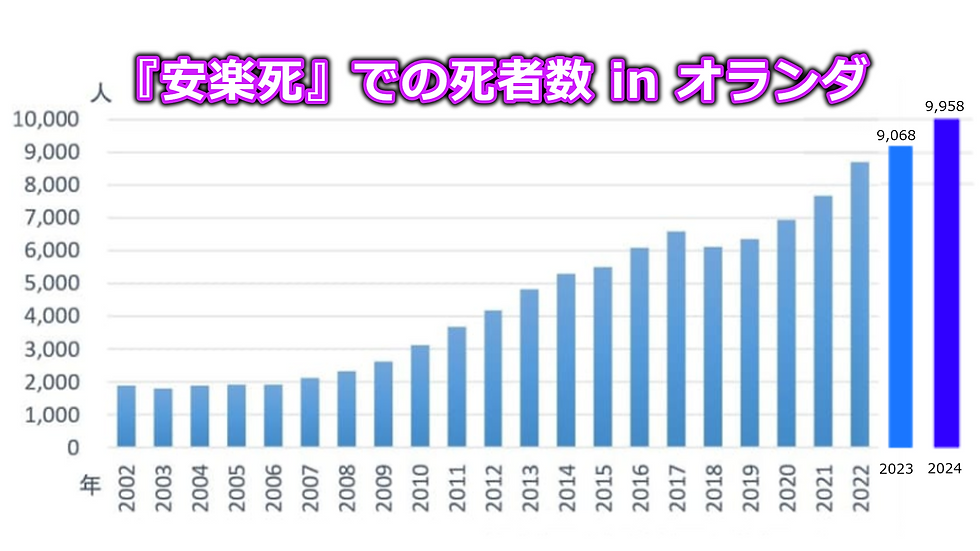

*NVVE's 2024 Euthanasia Annual Report
Looking at the breakdown,

Most euthanasias are
At a rate of 86.29%
"Cancer, nervous system disorders, lung disorders, cardiovascular disorders"
He had some underlying diseases such as:
The rest of the breakdown is as follows:
Euthanasia due to dementia : 427 cases (increasing)
Euthanasia due to mental illness : 219 cases
Under 18 : 1 case
Couple euthanasia (accompanied/double euthanasia) : 54 cases (increase from the previous year)
In 2024, former Dutch Prime Minister Jan van Acht and his wife made headlines both at home and abroad when they chose to undergo "couple euthanasia."

In addition, the 2020 acquittal of the defendant in the 2016 " coffee euthanasia case " (euthanasia for a dementia patient) has led to the development of legal systems and clarification of review standards .


*As mentioned above, the number of euthanasia cases due to dementia in 2024 was 427 (on the rise)
4. Main Eligibility Criteria (Dutch Euthanasia)
The legality of euthanasia is clearly stated in Article 2, Paragraph 1 of the Act on the Termination of Life and Assisted Suicide on Request.
These basic principles have not undergone any major revisions since their establishment in 2001 until the present (2024).
The six main criteria are:
The patient's request is spontaneous and carefully thought out
The patient's suffering is desperate and unbearable
The doctor has provided the patient with a sufficient explanation of the condition and prognosis.
Both the doctor and the patient concluded that no other reasonable solution existed.
At least one independent physician must provide an examination and written opinion
Euthanasia is performed through medical procedures
Additionally, the following additional points are important:
There is no distinction between terminal and non-terminal.
Even if you have a long life expectancy, you can apply if your pain is deemed unbearable .
Therefore, even those who are severely bedridden due to mental illness or quadriplegia may be eligible (although this may take time depending on the condition) if they meet the requirements.
The majority of people who request euthanasia have underlying illnesses, but in principle, whether or not they have an illness does not matter .
Any person may be eligible if they are experiencing "unbearable pain and extreme discomfort" and are suffering to the point of breaking through their mental limits .
Age requirement : The 2023 amendments now allow euthanasia for children aged 1 to 11 under certain conditions (parental consent required).
Duo-euthanasia : In 2016, it began to be applied individually within the framework of existing euthanasia laws , and 54 cases have been confirmed by 2024.
5. Specific examples of implementation (Euthanasia in the Netherlands)
As mentioned above, in the Netherlands, serious physical illnesses such as cancer, neurological diseases, pulmonary diseases, and cardiovascular diseases account for approximately 86% of euthanasia requests.
On the other hand, the number of cases of euthanasia related to dementia and mental illness is increasing year by year, and this is a topic of ongoing social debate.
As a symbolic event,
"Coffee Euthanasia Incident" (2016-2020)
One example is the case of a 29-year-old woman who died of euthanasia due to mental illness (2023). The latter case attracted worldwide attention after she publicly disclosed her condition on social media. I will discuss mental illness in a separate article.

As mentioned above, the option of "ending one's life together," such as couple euthanasia, has sparked ethical and religious debate, once again leading to questions about the merits of the system across Europe.
6. Evaluation of the system and historical background
The Dutch euthanasia system is not simply a medical system, but is highly regarded as a social model that places individual dignity and the right to self-determination at its heart .
More than 20 years have passed since the system was established in 2001, and today the Netherlands has built up such a track record that it is referred to as " a country that has almost completely overcome the issues surrounding euthanasia ."
The Dutch euthanasia system has had a major influence on later countries that have legalized euthanasia, and the structure of the system has been adapted to suit each country's circumstances, to a greater or lesser extent, based on the Dutch experience.
The civic group that supports this system, NVVE (Dutch Society for Voluntary Euthanasia) , was founded in 1973 and continues to publish annual reports and ethical guidelines.
In addition, in the Netherlands, euthanasia is not seen as a system that allows people to choose death, but as the freedom to choose the end of one's life .
On the other hand, some opponents have criticized the system, citing the Nazis' forced euthanasia policies, such as Operation T4 during World War II, but it is clear that the modern system exists in an entirely different context, one that respects individual will and legal procedures .

*This is a historical episode from 1939 to 1941 and is not an opposing factor .
There is no point in talking about a society in an era when there was no internet, mobile phones, televisions, refrigerators, or washing machines .
It would be a stretch to think that using the term "eugenics" would make the story relevant to the present day.

"Nazis, Hitler, Eugenics, and Operation T4"
These words have become essential items of vocabulary among those who oppose euthanasia, and are frequently used as opposition phrases as a hidden alternative to the claims of groups (mainly Protestant evangelicals ) who find it difficult to oppose euthanasia by bringing Christian doctrine to the forefront (especially in Japan, where the single doctrine of monotheism is not familiar) .
"Euthanasia is suicide and a despicable act that goes against (Christian) bioethics."
"Suicide is a blasphemous and shameful act that betrays God."
"As in the Passion of Christ, 'suffering has meaning'"
As mentioned above, they have a hidden Christian bioethic, but if they use that as a basis for opposing euthanasia, they will be "shocked," especially in Japan. Therefore, they have devised alternative arguments and sometimes even spread false information to support their opposition.
Incidentally, in Germany , private euthanasia associations have existed since the 1980s , and now, following a court ruling in 2000, euthanasia is officially recognized . Of course, this is a modern system that is completely different from the practice of eugenics.
The Dutch euthanasia system is a world-leading model, built on a long historical process, a sophisticated legal system, and civic agreement . It is not simply a "system of death," but a social mechanism that guarantees the freedom of human beings to end their lives with dignity .
![[Dutch Euthanasia #2] Details of the process from application to completion based on the contents of the Dutch Euthanasia Bill, and safeguards to avoid the risk of coercion](https://static.wixstatic.com/media/1e6e15_d8b728feeea440529bf7bfd12c920fdc~mv2.png/v1/fill/w_980,h_551,al_c,q_90,usm_0.66_1.00_0.01,enc_avif,quality_auto/1e6e15_d8b728feeea440529bf7bfd12c920fdc~mv2.png)