
[Euthanasia in Spain #1] History and Current Status
- リップディー(RiP:D)

- Nov 17
- 4 min read
[Spain Euthanasia] History and current status
Overview of the system (Euthanasia in Spain)
In Spain, the euthanasia system (Eutanasia/Ayuda para morir) was officially legislated in June 2021. This law allows patients suffering from serious illnesses or unbearable pain to receive assistance in ending their lives from a doctor, provided they meet certain requirements and procedures.
In the first year since the system was introduced, 180 people underwent euthanasia , 22 of whom donated their organs , and 68 transplant surgeries were completed .

Minister of Health celebrates the first anniversary of the system's establishment
The number of applications in recent years is as follows:
・2022:
576 applications → 288 implemented (50%)
・2023:
727 applications submitted - 323 approved (44%)
The reason for the declining approval rate is thought to be the slowness of administrative procedures and strict screening in Spain (see below).
The Spanish Euthanasia Association , DMD (Derecho a Morir Dignamente) , is actively involved in implementing the system and leads the exchange of information about euthanasia throughout the Spanish-speaking world.
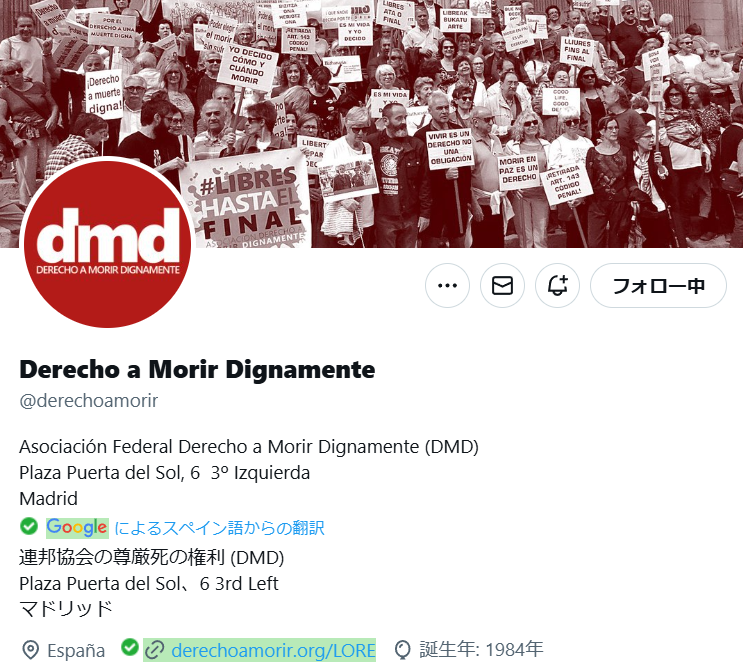

* Please read " death with dignity" as "euthanasia ."
Ramon Sampedro and the establishment of euthanasia
The establishment of Spain's euthanasia system was the result of decades of civic activism, judicial decisions, and social debate. The decisive turning point was the Ramon Sampedro case (1998) . It was made into a film that won the Academy Award for Best Foreign Language, and it was a hot topic in Japan, so many people may have seen it.

Background of the incident
・1969 :
Ramon Sampedro becomes quadriplegic in diving accident

* Actual accident scene

・1993 :
Publicizing the "right to die" and taking legal action
・1998 :
With the help of his collaborator Ramona Maneiro, he committed suicide by taking poison.
Seven years after the statute of limitations expired, his best friend Maneiro confessed on a TV program that he "did it for love." After turning on the video camera, he was in the same room as him, watching over him from behind the camera until the very end.

・1999 :
The government holds its first public hearing due to social repercussions
・2004 :
The film "The Sea Inside" becomes a worldwide hit
→ International attention deepens domestic debate
・2009 :
75% of the public supports euthanasia
・2017 :
Approval rate: 85%
・June 2021 :
Euthanasia system officially established
The establishment of Spain's euthanasia system is a typical example of how "individual suffering and complaints" were elevated to "social debate," which eventually resulted in legislation.
However, it was more than 20 years after his death and the film's success that the law was enacted. It is also worth noting that during that time, the DMD Society and national movements continued to desperately appeal for the establishment of the law.
Latest trends
Spain's current euthanasia system has many problems, one of which is the slowness of the procedure .
① Slow procedures
Although a decision should be made within one month of application, it actually takes an average of 75 days .
The DMD has strongly criticized this, pointing out that " one in three applicants dies before the review is completed ."

② The small number of cases compared internationally
Although Spain's annual death toll is around 400,000, the number of euthanasia cases is still very low compared to other countries.
Although the system has been established, access is by no means easy due to the bureaucratic nature of the administration and the cautious attitude of doctors.
Spain was a latecomer to the system, but it will need to continue improving the system while balancing safety and accessibility.
Eligibility Criteria
The main conditions of the Spanish euthanasia system are:
1. Serious and incurable diseases
- A state in which physical and mental pain is "unbearable."
- The prospects for treatment are extremely poor.
2. declaration of intention
- The patient expresses their wishes multiple times
・Mental competence is confirmed
3. Double examination by doctors
・Reviewed by the attending physician and an independent second physician
・Final check by the judging committee
4. It is a last resort
-Other options, such as palliative care, are available
However, the strict enforcement of these conditions is also contributing to the low approval rate.
The review method and specific process will be explained in a separate article, referring to the details of the Euthanasia Bill.
Historical background
The Spanish euthanasia system was established as a response to the profound question of how society should respond to the suffering and dignity of individuals . In this respect, it can be assumed that the system was heavily influenced by the Dutch euthanasia system.
A common phenomenon in many countries where euthanasia is legal is
One point is that "those who were suffering moved society with their own words."
In Spain, too, the actions of the parties involved, led by Ramon Sampedro , served as the starting point for social debate, overcoming religious backgrounds ( more than 90% of Spaniards are Catholic ) and achieving consensus.

![[Euthanasia in Spain #2] The process from application to completion, as seen from the contents of the Spanish Euthanasia Bill; Safeguards to avoid the risk of coercion](https://static.wixstatic.com/media/1e6e15_f9f84fb572da419db79bab7d10dfd1b3~mv2.png/v1/fill/w_980,h_551,al_c,q_90,usm_0.66_1.00_0.01,enc_avif,quality_auto/1e6e15_f9f84fb572da419db79bab7d10dfd1b3~mv2.png)