
[Euthanasia in Peru #1] The History and Current Situation of Euthanasia in Peru: Ana Estrada's Pavement to a "Dignified End"
- リップディー(RiP:D)

- 3 days ago
- 4 min read
[The History and Current Situation of Euthanasia in Peru: Ana Estrada's Pavement to a Dignified End]

I. The historic event of Peru's first euthanasia
On April 21, 2024, Ana Estrada , who had suffered for many years from a severe progressive illness, became the first person in Peru to undergo medically assisted termination of life (also known as euthanasia) and pass away.

Video of the news report at the time translated into Japanese
Provided by "Mufumufu" channel
Ana Estrada was not just a case; she became a symbol of profound change in Peru's medical ethics, judicial system, and religious views .
Her struggle transformed the debate over the "right to self-determination at the end of life" in the Catholic nation of South America, and was a decisive turning point that led to the euthanasia bill currently under consideration in the Diet.
II. The beginning of the legal struggle (2016)
—The voice of one citizen calling for a "dignified end"—
In 2016, psychologist Ana Estrada, who had lost most of her respiratory and motor functions due to the progression of the incurable disease polymyositis, filed a lawsuit against the Peruvian government demanding that she be granted the right to "access to euthanasia" in order to end her life in dignity.

At the time in Peru, euthanasia was clearly prohibited, and doctors who ended a patient's life in accordance with their wishes could be held criminally liable. Her lawsuit attracted attention as a historic case that sharply contrasted the individual's right to self-determination with the state's obligation to protect life.
III. 2022: Groundbreaking "Special Individual Case Ruling"
—Immunity applied only to individuals, not to institutions—
After five years of deliberations, the Supreme Court ruled in February 2022 as follows:
"We will not punish the doctors for their actions in ending Mr. Estrada's life."
This ruling did not legalize the entire system, but was a special measure limited to her .
This framework, while similar to Italy 's previous individual exemption decisions , was an extremely unusual decision in Peru.
However, this trial sent shock waves not only in Peru but throughout South America.
The very fact that euthanasia was legally recognized in a country with a strong Catholic culture was a turning point in society.
IV. Peru's Religious Background and Social Change
— Even in a “Catholic country,” people’s attitudes change —
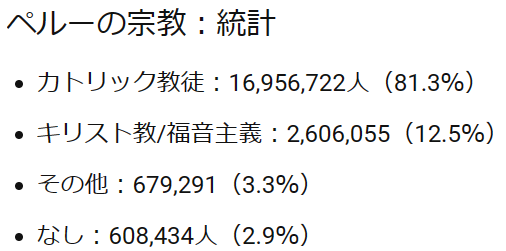
In Peru, 94% of the population is Christian , and Catholicism has had an extremely large influence historically and politically.
However, with the spread of the internet and AI technology , the religious views of the younger generation are rapidly becoming secularized .
When Anna appealed for the need for "the freedom to choose a dignified end" through her blog and social media, the majority of the media and the general public expressed support, which could be seen as a sign that traditional views on religion are beginning to waver .
Naturally, there was also strong opposition from religious groups and traditional conservatives.
However, the general public's support for her outweighed that .
*The following is a post from the opposition


⇩

Provided by "Mufumufu" channel
⇩

A fanatical believer in Christian Catholicism

⇩

⇩

⇩

In modern times, Christianity and religion in general have become unpopular around the world , so they tend to hide their true identities as much as possible . This organization, Origen, also does not put a religious streak on the forefront (this is a global trend).
This is also shared by most people who oppose euthanasia (e.g., disability groups, palliative care physicians ) .
And as a minority, one of their characteristics is that they are " loud-voiced ." Hiding their Christian bioethics , they are trying to oppose euthanasia by making use of misinformation and conspiracy theory approaches.
I will introduce this in another article, but in Japan, the following types of things fall into this category.
Provided by "Mufumufu" channel
The Japanese media has a "taboo on reporting on religion" or "taboo on thorns ," so hidden Christians do not appear in public.
V. Courageous Lawyer: Josefina Miro Quesada
—The other protagonist who brought citizen voices to the judiciary—
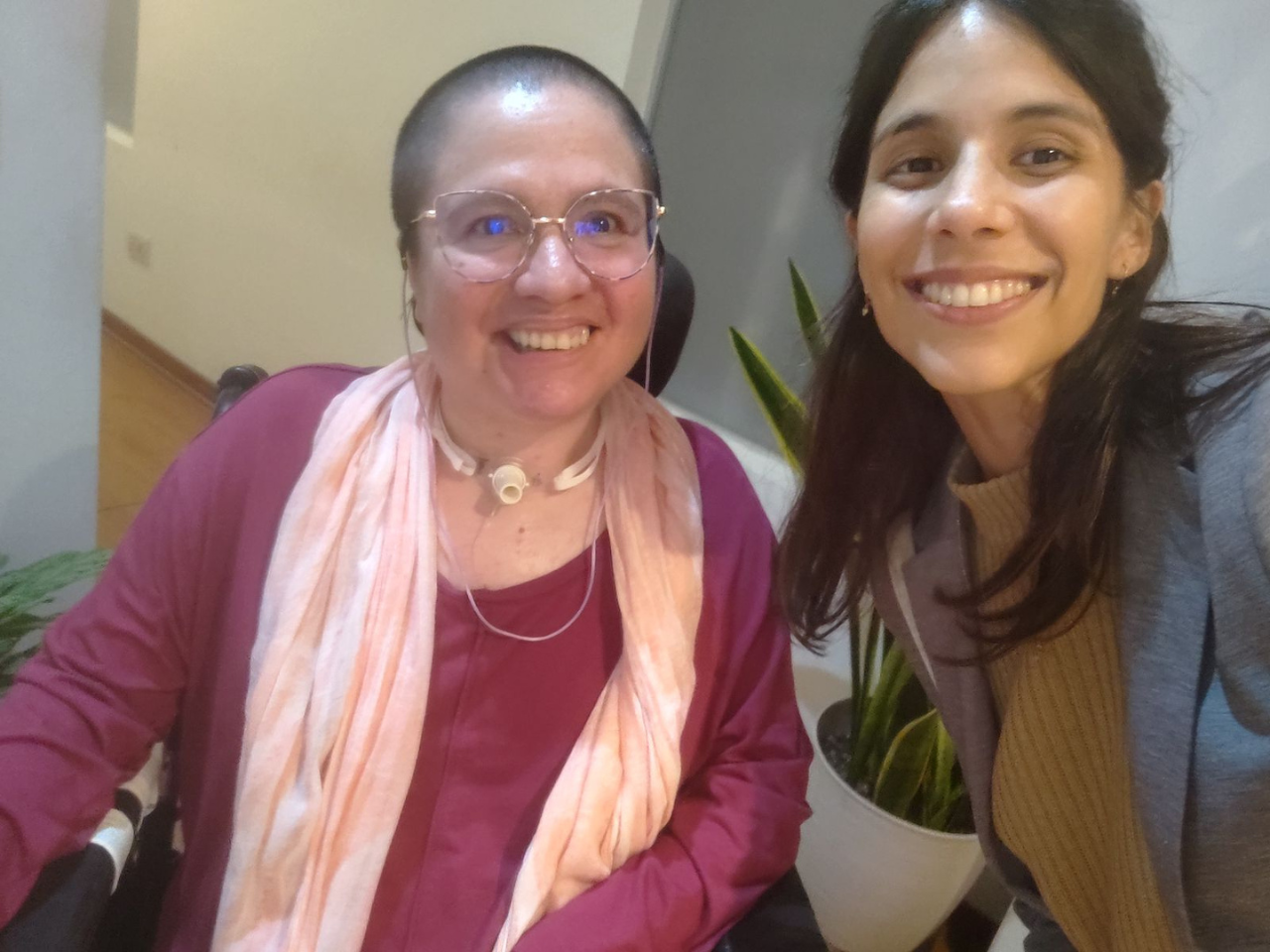
Supporting Ana's fight was lawyer Josefina Miro Quesada Gayoso (right).

She learned about Anna's allegations on television and was deeply moved, so the next day she spoke to her boss and offered to defend her.
Her dedicated support and exceptional legal strategy were the driving force behind our ultimate victory.
This lawsuit is a classic example of "citizens expanding human rights," achieved through the courage and cooperation of two women.
The details of their meeting and battle are written in detail on the website below.
VI. April 2024: A peaceful end
—The moment when individual dignity moved the law and society—
Ana Estrada will be born on April 21, 2024.
He passed away peacefully, surrounded by his family and Josephina.
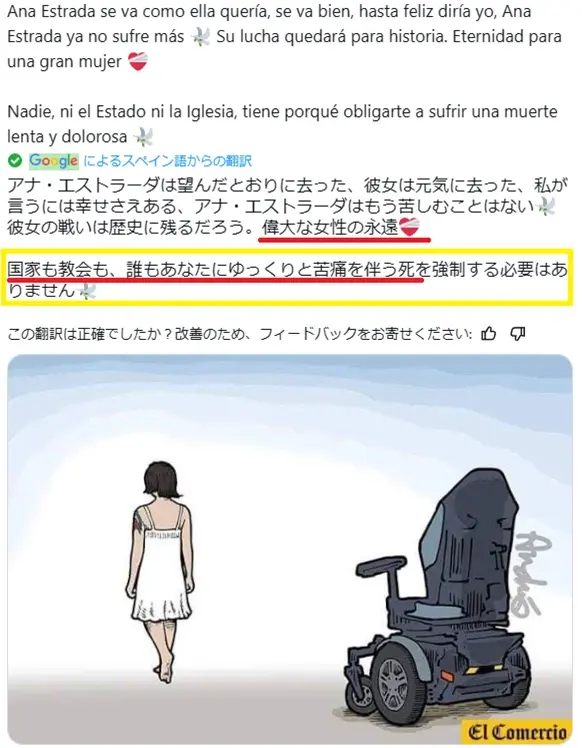
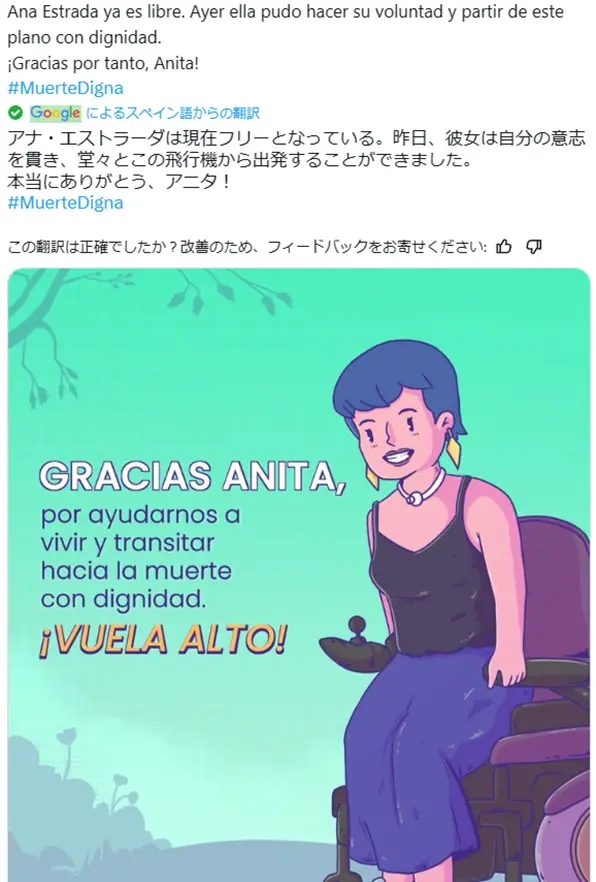
On social media (X), around 85% of people posted messages praising her courage, and the phrase " Vuela alto, Anita" (Fly high, Anita) was widely used in memory of her.
Although there was strong criticism from a small number of conservative Christians, the overall trend in society was clearly in support.

Provided by "Mufumufu" channel
An interview with Anna's lawyer the day after she was euthanized
VII. Historical Impact: Bill introduced one month after death
- Towards a new stage of institutionalization -
Just one month after Anna's death, a formal euthanasia bill was introduced in Parliament.

This is a move that goes beyond a special ruling and seeks to establish euthanasia as a system , and is seen as a crucial turning point in the history of end-of-life care in South America.
VIII. Position in South America
—From religious control to individual rights—
Although Catholicism still has a strong influence in South American countries, countries such as Chile, Colombia, and Argentina are rapidly becoming more liberal (≠ Japanese liberalism) in the area of human rights, including reproductive health and LGBTQ rights.
Peru is also joining this trend, and Ana Estrada's lawsuit and its social repercussions can be said to be a symbol of the ``end-of-life rights revolution'' in South America.


Ⅸ. A "door to history" created by one citizen
The battle between Ana Estrada and her lawyer, Josefina,
It freed Peruvian society from conservative religious views and significantly changed the future of end-of-life care.

Her death is not the end
This will be remembered as the "starting point" for the legalization of euthanasia in Peru.
"Vuela alto, Anita❤️🕊️"